
The Cross-Border Opportunity: What RBI's BRICS CBDC Corridor Proposal Means for Indian Banks With NRI Customers
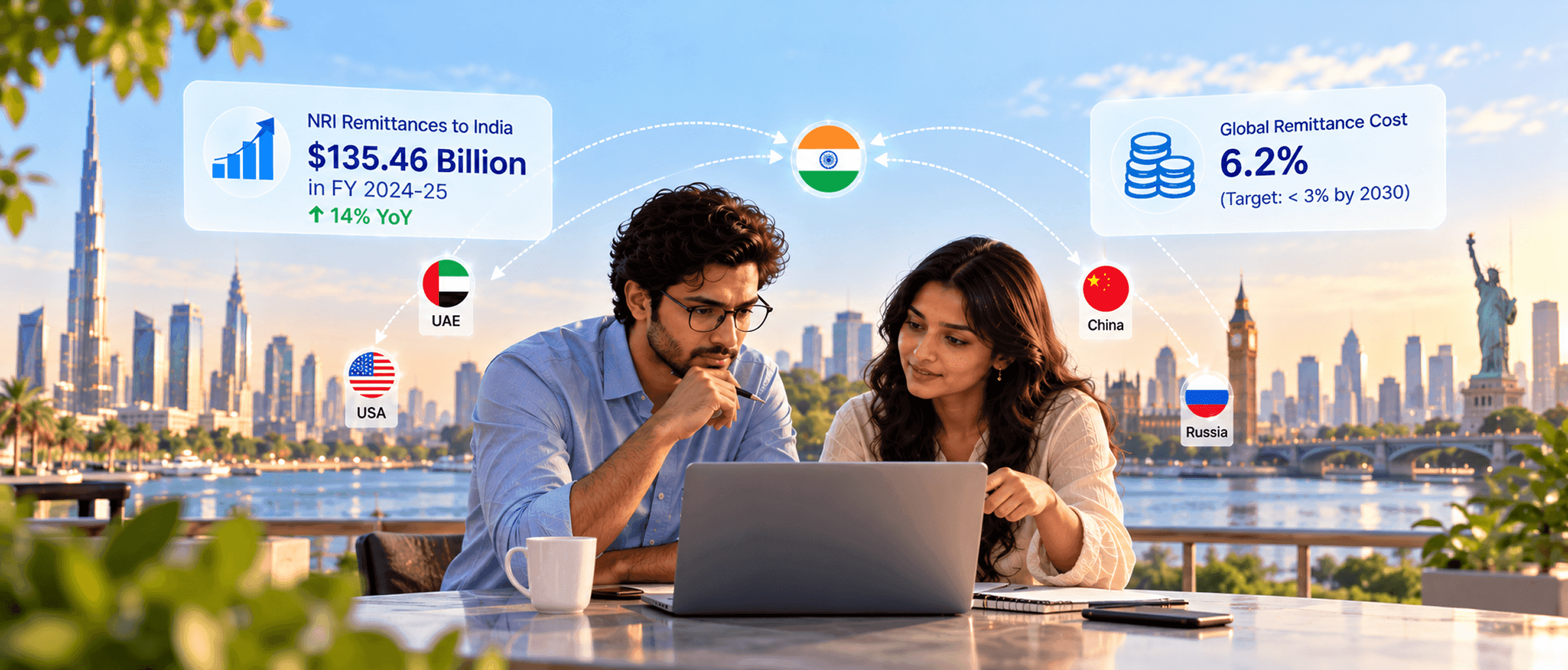
India received $135.46 billion in NRI remittances in FY 2024-25 - a record high, up 14% year-on-year - making India the world's largest remittance recipient, nearly double second-placed Mexico ($68 billion). [4] These flows now account for more than 10% of India's total current account receipts, exceeding inbound FDI of $81 billion in the same period. The UAE alone contributed approximately $21.6 billion - nearly 19% of the total - making it India's single largest remittance source. 5
The cost of moving this money is the central problem. The global average cost of sending $200 stands at approximately 6.2%, against the UN SDG target of under 3% by 2030. 6 Every percentage point of cost reduction across $135 billion in annual flows represents over $1 billion in value - redistributed between senders, recipients, and the financial intermediaries processing the transfer. The bank that controls even a fraction of that settlement infrastructure controls a durable, fee-generating asset.
In January 2026, Reuters reported that RBI recommended to the Union Government that linking BRICS nations' CBDCs be placed on the agenda for the 2026 BRICS Summit, which India is hosting as BRICS chair. 1 The expanded BRICS now includes UAE and Indonesia as full members. A digital rupee cross-border payments corridor covering the UAE-India flow is not a niche product. It is the largest bilateral remittance corridor India operates.
What RBI's BRICS CBDC Proposal Actually Is and What It Is Not
The RBI's proposal is not for a shared BRICS currency. What RBI is proposing is the interconnection of existing national CBDCs: India's e-Rupee linked with Brazil's Drex, Russia's Digital Ruble, China's e-CNY, and the digital currencies of newer BRICS members including UAE and Indonesia. A trader in India would settle a payment with a supplier in Brazil directly in their respective national CBDCs - eliminating the US dollar as an intermediary and the correspondent banking fees that come with it. RBI has been explicit that the initiative is about cost efficiency and settlement speed, not de-dollarisation ideology. 12
The INR's capital account convertibility constraint under FEMA 1999 is the critical nuance banks must understand before evaluating CBDC integration for financial institutions. Every cross-border CBDC transaction would need to be purpose-coded - categorised by transaction type (trade, tourism, NRI remittance) - and direction-controlled. RBI's framework would embed these controls programmatically into the e-Rupee token itself. This is not a limitation. It is the feature that makes the RBI BRICS CBDC corridor regulatory-friendly: programmability enforces compliance at the token level, not the reporting level. 3
For NRI remittances, the natural starting point is current-account flows - money sent to support family, service loans, or pay recurring domestic obligations - which are already permitted under FEMA. The bilateral infrastructure exists. UPI-PayNow (Singapore, February 2023) and UPI-UAE FPS (February 2023) are live corridors enabling instant consumer remittances. A CBDC corridor would operate at the wholesale and institutional layer on top of the bilateral regulatory trust those corridors have already established. 6
The Live Precedent: What mBridge Tells Banks About Cross-Border CBDC at Scale
The closest live comparable to RBI's proposal for cross-border CBDC settlement is Project mBridge - connecting the central banks of China, Hong Kong, Thailand, UAE, and Saudi Arabia. By early 2026, mBridge had settled over 4,000 cross-border transactions with a cumulative value exceeding $55.5 billion - a nearly 2,500-fold increase from its 2022 pilot phase. 7 China's e-CNY accounts for approximately 95% of total settlement volume. The architecture - a shared ledger with individual central bank nodes, each maintaining national monetary sovereignty, is the model RBI's BRICS proposal envisions. It demonstrates that cross-border CBDC settlement at meaningful commercial scale is technically achievable, not theoretical.
The UAE's presence on mBridge is directly relevant to any bank evaluating e-Rupee international settlement. The same country that is India's largest remittance source - contributing $21.6 billion in 2024 - is already operating on a multi-CBDC settlement platform alongside China. The bilateral central banking relationship and digital currency infrastructure between India's top remittance corridor and a live CBDC settlement platform is further along than the headline BRICS proposal suggests. 7
The honest qualification: none of the core BRICS members has fully launched a national CBDC. India's e-Rupee has more than 8 million retail users as of late 2025, with active programmability pilots running under DBT schemes in Gujarat, Puducherry, and Chandigarh in FY 2025-26. 8 A live India-BRICS CBDC corridor is a 3-5 year implementation horizon from policy approval. Banks should treat the RBI's proposal as a significant directional signal from India's most credible monetary authority - and the preparation window it opens as the actionable planning horizon.
What the Corridor Means for Banks With NRI Customer Bases
The CBDC revenue opportunity for banks with NRI customers operates on two tracks simultaneously. The first is the retail distribution layer: the bank whose NRI customers send remittances home through a CBDC-enabled channel, whose domestic merchants accept CBDC-settled NRI payments, and whose transaction data from those flows enables cross-sell into NRI-specific products - FCNR(B) deposits, NRE account upgrades, NRI home loans, insurance. The NRI customer's recurring India obligations - EMI repayments, insurance premiums, school fees, property maintenance - are exactly the use cases for programmable CBDC that RBI has already validated domestically, and the natural product to offer through a corridor-enabled bank channel. 5
The second track is data. Every cross-border CBDC transaction through a bank's platform creates a structured, verified record of an NRI customer's financial behaviour - remittance frequency, payment categories, obligation patterns. This is the same data asset that domestic CBDC generates for DBT beneficiaries, applied to the NRI segment: a real-time underwriting input enabling pre-approved NRI credit products and FCNR(B) retention strategies with conversion rates that cold outreach campaigns cannot approach. The CBDC revenue opportunity for banks is not the corridor fee alone. It is the data asset the corridor generates.
The Regulatory Realities: What Banks Must Understand Before Positioning
The BRICS CBDC proposal remains a recommendation from RBI to the Union Government. As of July 2026, it has not been formally approved, placed on the 2026 BRICS Summit agenda, or endorsed by any other BRICS central bank. [1] Banks should plan accordingly: a directional signal worth preparing for, not an imminent deployment to react to.
Even if approved at the 2026 Summit, a live corridor requires technology standardisation across BRICS central bank architectures, multilateral governance frameworks, and bilateral regulatory agreements. mBridge - with five central banks and years of BIS-supported development - reached MVP stage in mid-2024 and is still not in full commercial operation for non-participant institutions. 7 The corridor will almost certainly be phased: current-account NRI remittances and trade settlement first, investment flows later under the FEMA framework. [3] Banks should plan RBI digital rupee infrastructure around those use cases - not investment flows. Banks that wait for the corridor launch to begin building will arrive 12-18 months late - which, in a first-mover market, is the same as arriving last.
Why Digiledge CBDC Positions Banks for the Cross-Border Opportunity Today
Banks in Kerala, Maharashtra, and Gujarat - which account for a disproportionate share of India's NRI deposit base - have a structural first-mover advantage if they build e-Rupee merchant acceptance and programmable wallet infrastructure before cross-border corridors formalise. The bank already live with CBDC infrastructure is the natural retail partner when the corridor launches. A bank starting from zero at corridor launch faces 12-18 months of build time - and loses the habit formation that early adoption creates with NRI customers who have begun using a competitor's CBDC-enabled channel for their recurring India payments.
When the BRICS CBDC corridor launches, the banks positioned to capture the retail distribution opportunity will be those already operating four capabilities: RBI certification and active CBDC pilot participation; programmable e-Rupee wallet infrastructure at the merchant and customer level; merchant acceptance networks capable of receiving purpose-coded tokens; and regulatory reporting aligned with RBI's CBDC framework. A bank building these at corridor launch is 12-18 months behind a bank that built them for domestic use cases first. The domestic deployment is not a stepping stone to the cross-border opportunity. It is the first phase of it.
Digiledge CBDC is an API-first, RBI digital rupee for banks solution enabling e-Rupee acceptance across merchant QR codes, POS terminals, and soundbox-triggered confirmations - built on microservices and Kubernetes architecture that absorbs every new RBI programmability parameter as a push update, not a re-architecture. [10] Offline functionality, validity-period restrictions, and purpose-coding are live features today. A bank deploying Digiledge's CBDC stack for a DBT programme or a merchant acceptance network in Kerala is simultaneously building the wallet architecture, programmability layer, and merchant onboarding model that a BRICS CBDC corridor will require - at domestic scale, before cross-border compliance complexity arrives. The same API infrastructure that Digiledge deploys for domestic CBDC is what cross-border e-Rupee settlement will extend. Banks with NRI customer bases have a 3-5 year window to build it. That window is now.
Digiledge, a Mintoak Company, helps cooperative and state banks build RBI-compliant CBDC infrastructure - the same foundation that cross-border e-Rupee corridors will require when they launch. If your bank serves NRI customers and is evaluating CBDC participation, speak to our team today.
Frequently Asked Questions
1. What is RBI's BRICS CBDC proposal and how does it affect Indian banks?
In January 2026, RBI recommended to the Union Government that linking the CBDCs of BRICS nations be placed on the agenda for the 2026 BRICS Summit, which India is hosting. The proposal envisions India's e-Rupee connected with the digital currencies of Brazil, Russia, China, UAE, Indonesia, and other BRICS members - enabling direct cross-border settlement without the US dollar as an intermediary. For Indian banks, the implication is structural: the institution that builds the domestic CBDC distribution infrastructure first becomes the natural retail partner for the corridor when it launches. Banks that have not yet engaged with RBI's digital rupee pilot are already behind the preparation curve.
2. How would a BRICS CBDC corridor change NRI remittances to India?
A live corridor would allow an NRI in Dubai or Riyadh to send e-Rupee-denominated payments directly to India - purpose-coded for specific uses such as EMI repayments, insurance premiums, school fees, or property maintenance - without routing through SWIFT or correspondent banks. Settlement would be faster and the cost of transfer lower than the current global average of 6.2% for a $200 remittance. For banks with NRI customer bases, this is a product upgrade, not just an infrastructure change: programmable CBDC NRI remittance gives the NRI customer control over how funds are used after arrival, while giving the bank a structured, verified record of that customer's recurring financial obligations in India.
3. What is the realistic timeline for a live India-BRICS CBDC corridor?
RBI's proposal has not been formally placed on the 2026 BRICS Summit agenda as of July 2026 and has not been endorsed by any other BRICS central bank. Even if approved at the Summit, a live corridor requires technology standardisation across BRICS central bank architectures, bilateral regulatory agreements, and interoperability protocols. The precedent from Project mBridge - which involved five central banks and years of BIS-supported development - suggests a 3-5 year implementation horizon from policy approval to commercial operation for non-pilot institutions. Banks should treat this as the preparation window, not a deployment countdown.
4. What CBDC infrastructure does a bank need before a cross-border corridor becomes available?
Four capabilities are required before a bank can participate meaningfully in a cross-border e-Rupee settlement corridor: active RBI certification and CBDC pilot participation; programmable e-Rupee wallet infrastructure at the merchant and customer level; a merchant acceptance network capable of receiving purpose-coded tokens; and regulatory reporting aligned with RBI's CBDC framework. Each of these is buildable today using domestic CBDC use cases - DBT programmes, merchant QR acceptance, government subsidy distribution. Banks that build this infrastructure for domestic use are simultaneously building the foundation for cross-border CBDC integration for financial institutions when the corridor goes live.
5. Which Indian banks and geographies are best positioned for the NRI CBDC opportunity?
Banks with concentrated NRI customer bases in Kerala, Maharashtra, and Gujarat hold a structural first-mover advantage - these three states account for a disproportionate share of India's NRI deposit base and remittance-receiving geography. The UAE-India corridor, which alone accounts for approximately 19% of India's total remittance inflows, is the highest-priority corridor given UAE's existing presence on the mBridge multi-CBDC platform. Banks in these geographies that have already begun CBDC pilot participation will be positioned as the retail distribution layer for the corridor on day one. Those that have not yet begun will face a 12-18 month build lag at exactly the moment NRI customers begin adopting corridor-enabled remittance products through competitors.
References
References
- 1.CoinDesk / Reuters - India's central bank proposes a plan to create CBDC link among BRICS nations; RBI recommended to Union Government that CBDC linkage be placed on 2026 BRICS Summit agenda. January 19, 2026. coindesk.com/markets/2026/01/19/india-s-central-bank-proposes-a-plan-to-create-digital-currency-link-among-brics-nations/
- 2.Modern Diplomacy - RBI's Digital Currency Proposal for the BRICS 2026 Agenda. BRICS CBDC linkage mechanics; RBI framing as cost efficiency and monetary sovereignty, not de-dollarisation. April 21, 2026. moderndiplomacy.eu/2026/04/21/rbis-digital-currency-proposal-for-the-brics-2026-agenda/
- 3.Modern Diplomacy - BRICS Payment Settlement: The Quest and Implications. INR FEMA constraints, purpose-coding requirement, phased corridor approach. January 29, 2026. moderndiplomacy.eu/2026/01/29/brics-payment-settlement-the-quest-and-implications/
- 4.NewsOnAir / RBI - Remittances by Indians working abroad scale record high of $135.46 billion in FY25; 14% YoY growth; India largest global recipient ahead of Mexico ($68B) and China ($48B). July 2025. newsonair.gov.in/remittances-by-indians-working-abroad-scale-record-high-of-135-billion-in-fy25/
- 5.RBI - Changing Dynamics of India's Remittances: Sixth Round Remittances Survey (2023-24). UAE share approximately 19% of total India remittance inflows. rbi.org.in Secondary: Gulf News / LuLu Financial Holdings CEO - UAE contributed approximately $21.6 billion in 2024; UAE-India corridor evolving from volume-driven to value-led digital ecosystem. gulfnews.com/gn-focus/how-digital-integration-and-exchange-rates-boost-uae-india-money-transfers-1.500425616
- 6.BharatNotes / World Bank Migration and Development Brief 2024 - India CY2024 remittances $129.1 billion; 14.3% of global remittances; highest share for any single country since 2000. Global average remittance cost 6.2%. UPI-PayNow (Singapore) and UPI-UAE FPS corridors live February 2023. bharatnotes.com/subjects/economy/indian-economy/remittances-nri-economy-india/
- 7.TradingView / BIS - Project mBridge: 4,000+ cross-border transactions; $55.5 billion cumulative value as of early 2026; 2,500-fold increase from 2022 pilot; participants: China, Hong Kong, Thailand, UAE, Saudi Arabia; e-CNY approximately 95% of volume; BIS MVP stage reached mid-2024. tradingview.com/news/cointelegraph:9c2c921fc094b:0-china-led-cbdc-project-mbridge-tops-55b-in-cross-border-payments/ bis.org/about/bisih/topics/cbdc/mcbdc_bridge.htm
- 8.Business Standard / RBI Annual Report 2025-26 - Retail CBDC users "a little more than 8 million" (RBI Deputy Governor T. Rabi Sankar, December 2025); programmability pilots in Gujarat (PDS), Puducherry (PMGKAY food subsidy), and Chandigarh under DBT schemes in FY 2025-26. business-standard.com/finance/news/retail-cbdc-transactions-hit-120-mn-value-crosses-28-000-crore-rbi-dg-125120501178_1.html
- 9.RBI - Concept Note on Central Bank Digital Currency, October 2022. rbidocs.rbi.org.in/rdocs/PublicationReport/Pdfs/CONCEPTNOTEACB531172E0B4DFC9A6E506C2C24FFB6.PDF
- 10.Digiledge CBDC Product Page - Mintoak. API-first, RBI-compliant digital rupee solution; merchant QR, POS, soundbox acceptance; microservices and Kubernetes; offline, programmability, purpose-coding live. mintoak.com/products/digiledge_cbdc
Share on your socials