
How State and Cooperative Banks Can Generate Revenue Through Digital Rupee Merchant Networks
The Revenue Opportunity Banks Are Missing Inside RBI's CBDC Mandate
India's digital rupee is already delivering government subsidies to beneficiaries in Gujarat, Puducherry, and Chandigarh. The banks processing those transactions are generating revenue. The banks that are not yet live are watching that revenue accrue to their competitors.
For most cooperative and state banks, participation in India's retail CBDC pilot has meant one thing: compliance. A mandate from RBI, a box to tick, a pilot to join. The banks that are pulling ahead have taken a different view - treating the digital rupee not as a regulatory obligation but as a merchant acquisition channel and a direct revenue platform.
The numbers make the case. India's retail CBDC pilot has crossed 120 million transactions worth over ₹28,000 crore, as confirmed by RBI Deputy Governor T. Rabi Sankar in December 2025.1 The programme now spans 17 banks and 7 million users.2 Yet merchant coverage remains the binding constraint. As of June 2024, the pilot had 5 million users but only 0.42 million merchants - a 12:1 user-to-merchant ratio that RBI's own Currency and Finance Report flags as a structural gap.3 The bank that closes that gap in its geography first does not just process transactions. It captures every government DBT flow in that district, earns on each one, and builds a data asset that no competitor can replicate.
The scale of that opportunity is significant. The Government of India transferred ₹6.91 lakh crore via Direct Benefit Transfer in FY 2023-24 across more than 300 Central schemes and over 2,000 State schemes.4 In FY 2025-26, ₹4.16 lakh crore has already been transferred year-to-date across 327 schemes, with the year still running.5 RBI's Annual Report 2025-26 confirms that multiple DBT pilots using programmable CBDC were launched during the year across Gujarat, Puducherry, and Chandigarh - and that the programme will be widened to include additional DBT use cases in 2026-27.6
How DBT + CBDC Creates a Merchant Network Imperative for Banks
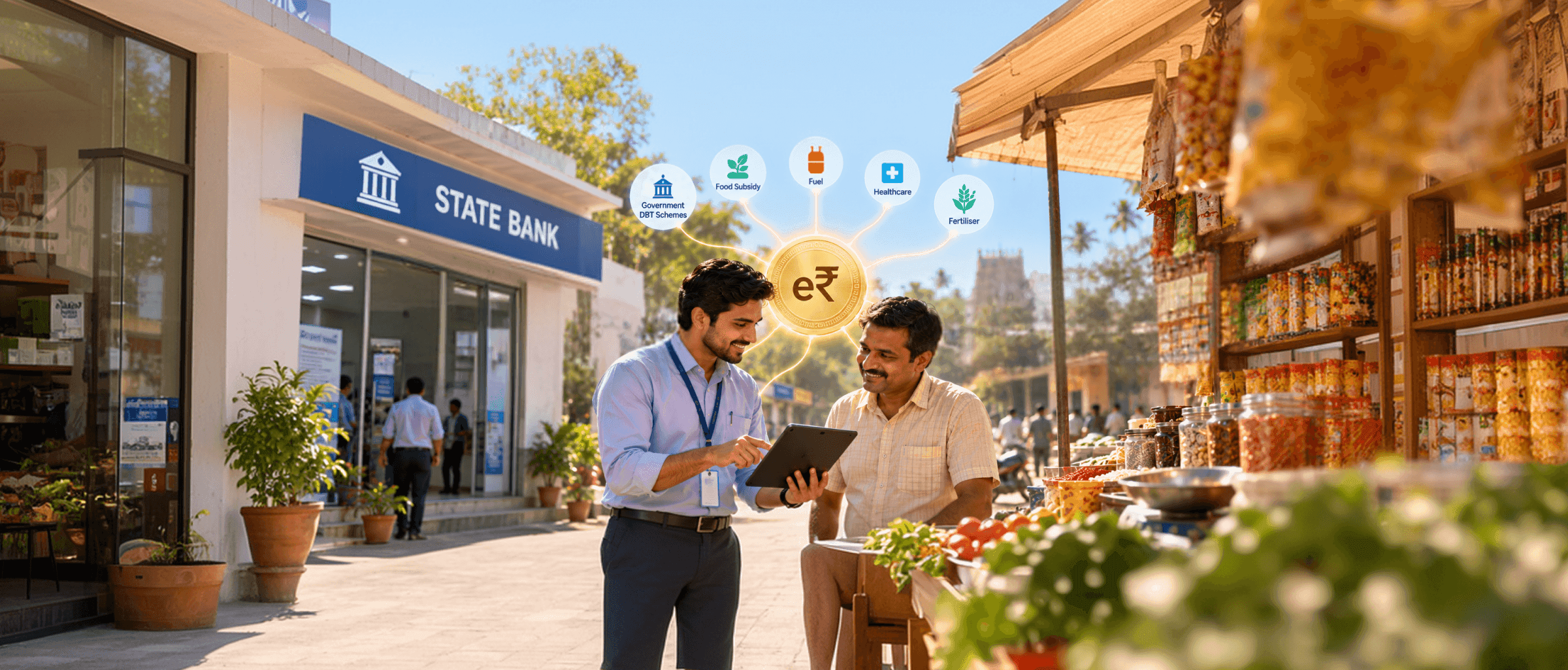
The mechanism that fuses DBT with merchant acceptance is programmable CBDC. Under the RBI's CBDC-R framework, government agencies can issue e-Rupee tokens that are redeemable only at authorised merchants, for specified purposes - fuel, food, fertiliser, healthcare - within defined geographies and timeframes. Programmability is enforced in real-time through a distributed Validation Service, ensuring that spending rules are checked before a transaction is completed rather than audited after disbursement. This is not a feature in development. It is already in production across multiple states.
Odisha's Subhadra Yojana, a women's welfare scheme with a total outlay of ₹55,825 crore over 2024–2029, provided the first large-scale test of this model. According to the RBI Annual Report 2024-25:
"Under Odisha's Subhadra Yojana, the e₹ has been used to disburse payments to around 88,000 beneficiaries." - RBI Annual Report 2024-257
Beneficiaries received programmable CBDC redeemable via UPI QR codes at authorised merchants - not cash that could be redirected, but purpose-bound digital tokens that flow directly into the merchant network of the distributing bank's geography.
From Pilot to Programme: The Live Deployments
The most significant live deployment to date is the CBDC-based Pradhan Mantri Garib Kalyan Anna Yojana (PMGKAY) food subsidy pilot, inaugurated in Puducherry on 26 February 2026 by Union Minister Pralhad Joshi in coordination with the Government of Puducherry, the RBI, PFMS, and Canara Bank.8 Food subsidy was credited directly to identified beneficiaries' digital wallets as CBDC tokens, redeemable exclusively at authorised Fair Price Shops and identified merchants. RBI's Annual Report 2025-26 confirms that the pilot has since been extended to Gujarat and Chandigarh.6
RBI Deputy Governor T. Rabi Sankar confirmed in December 2025 that discussions are ongoing with multiple central and state government agencies to utilise CBDC programmability for fund transfers with defined end uses.1 For cooperative and state banks with established district-level branch presence, this creates a structural first-mover advantage. They already serve the geographies where DBT beneficiaries live and the merchants where they spend.
The Revenue Architecture: How Banks Actually Make Money from CBDC Merchant Networks
The DBT-CBDC opportunity described above is not simply a volume story - it is a revenue architecture. Banks participating in the CBDC retail pilot operate as intermediaries between RBI, the issuer of the e-Rupee, and end users: both wallet holders and merchants. This is structurally analogous to the existing currency distribution model, but with revenue surface areas that physical cash does not offer. The primary revenue streams for a bank operating an active CBDC merchant network are:
-
Merchant onboarding fees. Banks charge setup fees for CBDC-enabled QR code provisioning and merchant wallet registration. For banks with pre-integrated merchant management infrastructure, this process can be automated at scale, keeping per-merchant cost low while the onboarding fee remains a direct margin line.
-
Government scheme infrastructure revenue. Banks that are empanelled as the settlement and distribution partner for a state DBT-CBDC programme monetise multiple points in the flow: DBT disbursement services, sponsor-bank relationships, purpose-wallet operations, merchant onboarding, and ongoing merchant servicing. Each of these is a discrete, recurring fee arrangement.
-
Future transaction-based monetisation. Unlike UPI, where the government's zero-MDR framework has constrained interchange on P2M flows, CBDC introduces the possibility of future transaction-based monetisation models as the ecosystem matures and commercial frameworks evolve. Banks that are live and processing volume when those frameworks are formalised are best positioned to benefit from them.
-
Credit cross-sell from programmable spending data. Programmable CBDC creates a structured, purpose-tagged transaction ledger at both the merchant and beneficiary level - creditworthiness data that does not exist in this form anywhere else. A cooperative bank can observe that a DBT beneficiary consistently redeems fuel allowances at a specific petrol pump, or that an MSME merchant's CBDC P2M volumes are growing steadily. This feeds pre-approved working capital products and targeted credit offers with a precision that cold outreach cannot match.
Together, these streams represent a revenue model that is more durable than a one-time acquisition fee model and more defensible than a pure transaction-processing arrangement.
Step-by-Step Implementation Sequence for State and Cooperative Banks
The following sequence is drawn from the structure of live CBDC deployments in India. Each step has dependencies - skipping or compressing them creates downstream delays that are difficult to recover from.
1. Pilot participation registration. Banks not yet in the RBI CBDC pilot must apply through the formal two-tier onboarding process. Under this structure, RBI issues e-Rupee to intermediary banks, who in turn provision wallets to end users. Confirm your bank's regulatory standing and apply via the RBI's CBDC pilot framework before initiating any merchant or user activation.
2. Merchant network identification and segmentation. Define the merchant cohort before deploying CBDC acceptance infrastructure.
Priority tiers should be:
(a) Fair Price Shops and PDS-aligned merchants in your district footprint - these are the guaranteed flow recipients in any state-level DBT-CBDC programme. (b) MSME merchants already on your merchant banking platform who can receive P2M CBDC payments. (c) Corporates for employee allowance programmability.
The Puducherry PMGKAY pilot required a pre-defined authorised merchant list before tokens were issued to beneficiaries - your bank's speed to define this list determines your inclusion in state government DBT deployments.
3. API-first CBDC stack integration. The bank's CBDC acceptance infrastructure must integrate with RBI's e-Rupee issuance framework, provision QR codes for merchant P2M acceptance, and support wallet management for retail users. A production-ready CBDC platform should provide: a support portal, merchant onboarding tooling, DBT upload functionality, purpose wallet operations, token intelligence, and regulatory reporting. An API-first, microservices-based architecture is essential - RBI is continuously adding programmability features that require rapid iteration without re-architecting the entire deployment.
4. State government and ministry engagement. With a merchant network identified and a technical stack live, the bank's business team should proactively engage state government departments - Food and Civil Supplies, Agriculture, Women and Child Development - that operate DBT schemes in your geography. The Puducherry and Odisha deployments are replicable templates. The bank that approaches a state government with an active merchant network and a ready CBDC infrastructure is a credible implementation partner; one that approaches with only a technical capability is not.
5. Staff and merchant education. Technology readiness without adoption readiness is a deployment failure. Across Digiledge's deployments with Federal Bank, Karnataka Bank, Canara Bank, and Indian Bank, the bank-enablement model has consistently included structured education programmes for both bank staff and merchants - covering CBDC acceptance workflows, QR code display, payment receipt, and settlement reconciliation - delivered alongside the technology implementation, not as an afterthought. Adoption at the merchant level remains the rate-limiting step in most CBDC deployments, and banks that treat staff training and merchant onboarding as a parallel workstream rather than a post-go-live task consistently reach live transaction volumes faster.
Regulatory Compliance Framework: What Banks Must Have in Place
The regulatory framework governing CBDC-R has evolved substantially since the RBI's foundational Concept Note (October 2022).9 The launch of the CBDC Retail Sandbox at Global Fintech Fest on 8 October 2025 - open to both banks and fintechs for live testing of programmable and POS use cases - marked the transition from a closed pilot to an open innovation framework.
RBI Governor Sanjay Malhotra stated at the launch: "The CBDC retail sandbox will give innovators the space to experiment and build on top of the digital rupee."2
The RBI Annual Report 2025-26 signals a further expansion through the CBDC and Asset Tokenisation (CAT) Sandbox - a forthcoming framework for testing products built on CBDC infrastructure.6 The RBI's Digital Banking Channels Authorisation Directions (issued November 2025, effective January 2026) further confirmed CBDC's classification as a payment system, with compliance obligations distinct from prepaid instruments. 10
The key compliance obligations for bank participants are: maintenance of e-Rupee wallets as a liability on the bank's balance sheet; KYC and AML screening for all wallet holders at account opening; and transaction reporting to RBI in the format specified under the pilot guidelines.
Beyond Baseline: The Emerging Compliance Requirements
Programmability compliance is an emerging requirement that banks must anticipate ahead of deployment. When a state government issues CBDC tokens with geographic or use-case restrictions, the bank's platform must enforce those restrictions at the transaction execution layer - not in a post-facto audit. This requires a compliant CBDC stack capable of encoding and executing programmability parameters in real time. Offline CBDC capability is the next regulatory milestone. RBI has announced offline functionality for CBDC-R to enable transactions in areas with limited or no internet connectivity6 - directly relevant for cooperative and state banks whose merchant networks span semi-urban and rural geographies. This should be treated as an imminent requirement in any TSP evaluation, not a future feature.
RBI has also permitted selected non-bank payment system operators to issue CBDC wallets,7 which introduces a disintermediation risk at the wallet layer for banks that are slow to deploy. The bank's natural advantages - institutional trust, existing KYC, branch presence in target geographies - are only defensible while the bank is operationally active in the CBDC ecosystem. They do not automatically persist as non-bank wallets gain adoption.
Measuring ROI: The Three Vectors That Justify the Investment
A bank evaluating the investment case for CBDC merchant network deployment should model ROI across three distinct vectors:
Vector 1 - Merchant network revenue. Fee income from merchant onboarding, recurring government scheme infrastructure arrangements, and future transaction-based income as CBDC commercial frameworks evolve. The Canara Bank empanelment as the settlement and distribution partner for the Puducherry PMGKAY pilot is the live precedent for this model - a bank holding the merchant network in a beneficiary geography earns on every transaction in that flow, from infrastructure the bank controls and that competitors cannot replicate without replicating the merchant relationships and the government contract.
Vector 2 - Reduction in cash management costs. The RBI Concept Note on CBDC explicitly identifies reduction in cash management costs - which it estimates at approximately 0.5% of GDP annually9 - as a core design objective of the digital rupee. For cooperative and state banks with cash-intensive branch and field operations serving rural and semi-urban geographies, every CBDC transaction that displaces a physical currency movement reduces vault management requirements, ATM replenishment cycles, and currency handling overhead.
Vector 3 - Credit cross-sell from CBDC transaction data. Programmable CBDC generates a structured, purpose-tagged transaction ledger at the merchant and beneficiary level that does not exist in any other payment channel. Banks that own this data - as the issuing and settling institution - can build pre-approved working capital products for MSME merchants whose P2M CBDC volumes demonstrate consistent business activity, and targeted credit products for DBT beneficiaries whose spending patterns reflect financial reliability. This is the cross-sell infrastructure that positions the bank as the primary financial operating system for the SME and beneficiary economy in its geography.
Why Digiledge CBDC Is the Fastest Path from Pilot to Revenue
The CBDC-DBT integration is not a future regulatory scenario. The Puducherry PMGKAY pilot (February 2026) and Odisha's Subhadra Yojana are the templates that RBI and the Union Government have confirmed they intend to replicate across additional states and UTs.6 The question for cooperative and state banks is not whether CBDC-DBT programmes will scale in their geographies, but whether their bank will be the authorised merchant network operator when they do.
First-mover advantage in this context is structural rather than temporary. The bank that onboards and activates the merchant network in a district, and secures state government empanelment for a DBT scheme, becomes the default settlement partner for every subsequent government programme that routes through programmable CBDC in that geography. A competitor cannot replicate that position by improving their technology - they need to replicate the merchant relationships and the government contract.
For cooperative and state banks evaluating CBDC deployment partners, Digiledge CBDC is an API-first, blockchain-powered stack - and a production-ready, RBI compliant CBDC solution - that enables digital rupee acceptance across all payment touchpoints: merchant QR codes, POS terminals, and soundbox-triggered confirmations, without requiring a ground-up build. The platform is built on microservices and Kubernetes, which means it absorbs every new RBI programmability parameter - offline functionality, validity-period restrictions, geography-bound tokens - as a rapid push update rather than a re-architecture cycle. When RBI extends the CBDC framework, as it has done repeatedly since the 2022 pilot launch, Digiledge-deployed banks are live on the new capability before most competitors have finished scoping their internal response.
Digiledge was among the first platforms in India to innovate CBDC on BBPS rails, and built BOAT - Biller Onboarding and Automated Testing - for NPCI directly. This gives Digiledge a protocol-level relationship with the regulator that is not replicable by a new entrant. The platform's white-labelled merchant companion app, pre-integrated biller network, and bank-enablement model - which includes staff and merchant education programmes, not just technology delivery - have been deployed across Federal Bank, Karnataka Bank, Canara Bank, Indian Bank, and CSB Bank.
Digiledge, a Mintoak Company, helps state and cooperative banks go live with RBI-compliant CBDC merchant networks faster than any in-house build or legacy TSP. If your bank is evaluating CBDC participation or ready to move from pilot to revenue, speak to our team today.
Frequently Asked Questions
1. How does CBDC integration for financial institutions differ from UPI for merchant acceptance?
Unlike UPI, which routes transactions through third-party payment rails under a zero-MDR mandate, CBDC integration for financial institutions places the bank directly in the issuance and settlement chain. The bank provisions the merchant wallet, enforces programmability parameters at the transaction layer, and earns on every P2M flow - a revenue position UPI does not offer.
2. What is the CBDC revenue opportunity for banks in DBT-linked merchant networks?
The CBDC revenue opportunity for banks spans three streams: merchant onboarding fees on QR provisioning and wallet registration; recurring income from DBT disbursement services, purpose-wallet operations, and merchant servicing under state government empanelment; and credit cross-sell enabled by the structured, purpose-tagged transaction data that programmable CBDC generates at the merchant and beneficiary level - data that no other payment channel produces in this form.
3. What does RBI digital rupee compliance require from banks operating merchant networks?
RBI digital rupee for banks requires: e-Rupee wallets maintained as balance sheet liabilities; KYC and AML screening at wallet onboarding; transaction reporting per RBI pilot guidelines; and enforcement of programmability restrictions - geographic, time-bound, and purpose-specific - at the transaction execution layer, not in post-facto reporting. The CBDC Retail Sandbox (October 2025) and Digital Banking Channels Directions (January 2026) define the current compliance framework.
4. Is a CBDC API for banks in India available, and what does implementation involve?
A CBDC API for banks in India is available through RBI-certified technology partners operating within the two-tier CBDC pilot framework. Implementation involves integration with RBI's e-Rupee issuance framework, QR provisioning for merchant P2M acceptance, purpose wallet operations, and regulatory reporting modules. An API-first, microservices-based architecture is essential to absorb ongoing RBI programmability updates - validity periods, geo-restrictions, offline capability - without re-architecture.
5. How does a DBT CBDC merchant network give cooperative banks a first-mover advantage?
A DBT CBDC merchant network is geography-specific by design - programmable tokens are redeemable only at authorised merchants within defined districts. The bank that onboards and activates that merchant network first, and secures state government empanelment for a DBT scheme, becomes the default settlement partner for every subsequent welfare programme routing through programmable CBDC in that geography. This position requires replicating merchant relationships and a government contract - not just technology.
References
- 1.Business Standard - Retail CBDC transactions hit 120 mn, value crosses ₹28,000 crore: RBI Deputy Governor T. Rabi Sankar, 5 December 2025. business-standard.com/finance/news/retail-cbdc-transactions-hit-120-mn-value-crosses-28-000-crore-rbi-dg-125120501178_1.html
- 2.Inc42 - RBI Launches CBDC Retail Sandbox For Fintech Players; RBI Governor Sanjay Malhotra at Global Fintech Fest; 7 million users across 17 participating banks, 8 October 2025. inc42.com/buzz/rbi-launches-cbdc-retail-sandbox-for-fintech-players/
- 3.Business Standard / RBI Currency and Finance Report - CBDC retail pilot: 5 million users vs 0.42 million merchants as of June 2024. business-standard.com/finance/news/cbdc-retail-pilot-customers-grow-to-5-million-till-june-2024-rbi-report-124072901187_1.html
- 4.DD News / Cabinet Secretariat - The Digital Transformation and Efficiency of India's Direct Benefit Transfer Model. Total fund transfer ₹6,91,300 crore in FY 2023-24. ddnews.gov.in/en/the-digital-transformation-and-efficiency-of-indias-direct-benefit-transfer-model-2/
- 5.DBT Bharat Mission - FY 2025-26 year-to-date: ₹4,16,428 crore transferred across 327 schemes (as accessed June 2026). dbtbharat.gov.in
- 6.RBI Annual Report 2025-26 / Business Standard - Confirms DBT-CBDC pilots in Gujarat, Puducherry and Chandigarh during 2025-26; offline CBDC announced; CAT Sandbox for 2026-27, 29 May 2026. business-standard.com/finance/news/rbi-cross-border-cbdc-pilots-digital-currency-2026-27-126052900721_1.html
- 7.RBI Annual Report 2024-25 (Chapter on Payment and Settlement Systems) - CBDC-R pilot: 17 banks, 60 lakh users. Subhadra Yojana: 'the e₹ has been used to disburse payments to around 88,000 beneficiaries.' rbidocs.rbi.org.in/rdocs/AnnualReport/PDFs/01ASSESSMENT290520252C1E3001DF03471CA4DB97E69C306E2F.PDF
- 8.NewsOnAir / PIB - Union Minister Pralhad Joshi inaugurates CBDC-based Food Subsidy Distribution programme under PMGKAY in Puducherry, 26 February 2026. newsonair.gov.in/union-minister-pralhad-joshi-inaugurates-cbdc-based-food-subsidy-distribution-programme-in-puducherry
- 9.RBI - Concept Note on Central Bank Digital Currency, October 2022. rbidocs.rbi.org.in/rdocs/PublicationReport/Pdfs/CONCEPTNOTEACB531172E0B4DFC9A6E506C2C24FFB6.PDF
- 10.MediaNama - RBI Digital Banking Channels Authorisation Directions, 2025, issued 28 November 2025, effective 1 January 2026. CBDC confirmed as payment system. medianama.com/2025/12/223-rbi-digital-banking-channels-guidelines/
Share on your socials