
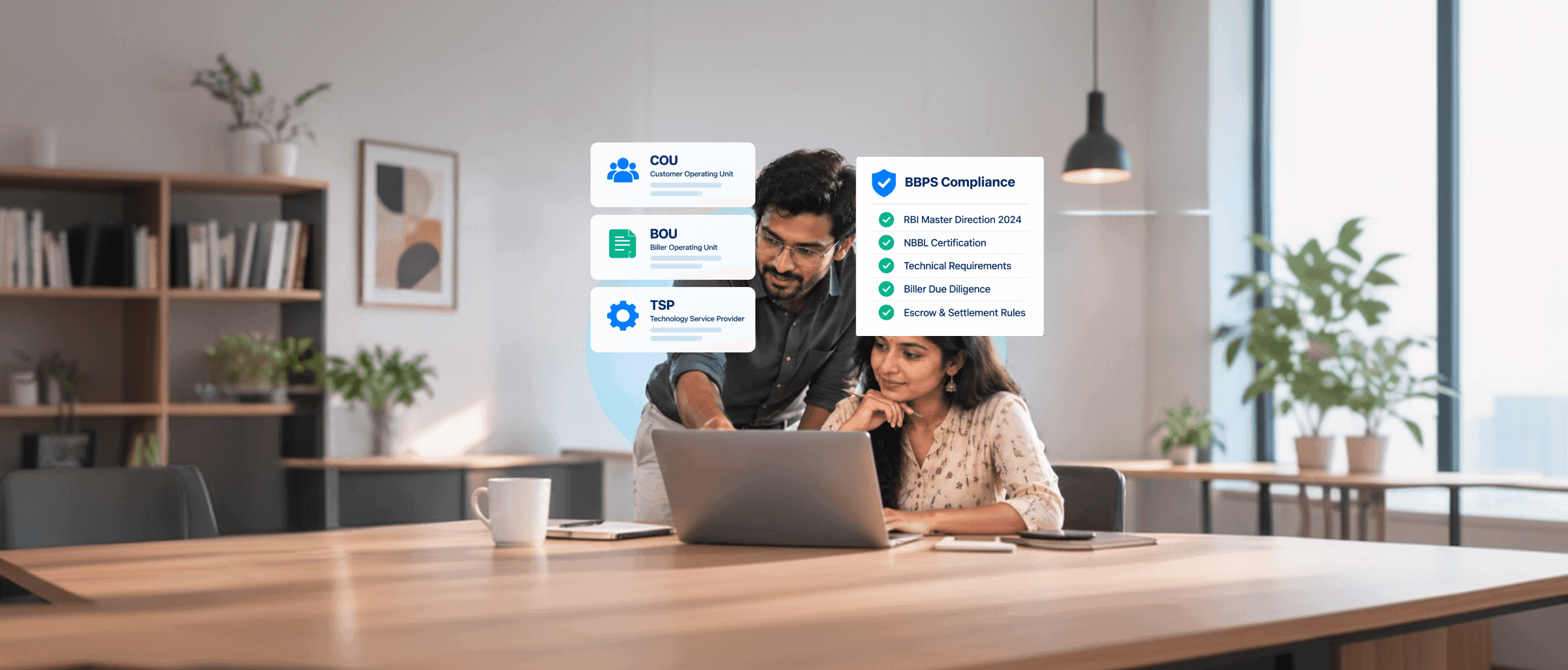
BBPS Compliance Guide: COU, BOU Certification and Vendor Requirements for Banks and Financial Institutions
Most banks and financial institutions approaching Bharat Connect ask an integration question: which platform, which API, which vendor. The RBI Master Direction (Bharat Bill Payment System) 2024, effective April 1, 2024, makes clear that the prior question is a compliance question.
Section 3(b) of the 2024 Master Direction explicitly prohibits any entity from operating a payment system for bill collection outside BBPS without RBI authorisation under the Payment and Settlement Systems Act, 2007. A bank or financial institution processing recurring bill collections through its app without operating as a certified Bharat Bill Payment Operating Unit (BBPOU) or formally partnering with one carries regulatory exposure, not just operational risk.1
The compliance liability extends to vendor selection. Per NBBL's Procedural Guidelines, if a bank onboards a TSP through its own BBPOU certification, the bank is responsible for ensuring that TSP's compliance with all NBBL certification documentation. A bank that discovers mid-deployment that its technology partner has not completed NBBL certification or has failed to implement a new BBPCU feature cycle on schedule inherits that exposure directly.2
_The 2024 Master Direction closed the gap that allowed informal bill payment services to operate without regulatory oversight. Any entity offering a bill payment solution for banks without NBBL certification is operating outside the legal framework. _
The Participant Structure: Who Does What, and What Each Role Must Certify
The Bharat Connect ecosystem operates through a tiered structure. NBBL (NPCI Bharat BillPay Limited) operates as the BBPCU, setting standards and handling clearing and settlement. Banks and eligible non-bank financial institutions participate as BBPOUs as COUs, BOUs, or both. TSPs provide the technical integration layer but are explicitly prohibited from handling settlement funds.1 3
Role breakdown
COU - Customer Operating Unit
- Provides the customer-facing digital or physical interface for bill payments.
- Must ensure access to all billers registered on the Bharat Connect platform.
- Must implement all BBPCU APIs and enhancements in a time-bound manner; every new BBPCU release creates a recertification requirement.2
- Every delay in implementing a new feature means the COU is out of compliance for that window; the sponsoring TSP carries this exposure alongside the bank.
BOU - Biller Operating Unit
- Onboards billers directly or through biller aggregators onto the Bharat Connect platform.
- Must conduct full biller due diligence, including on billers onboarded through aggregators under RBI's Payment Aggregator Guidelines and KYC Master Directions, 2016. 1 3
- Every biller in the network is a compliance obligation, not just a commercial relationship. A BOU with 500 billers has completed 500 due diligence exercises; biller network depth and compliance workload are inseparable.
- Earns on every transaction any Bharat Connect user makes with its onboarded billers, across all 72 active COUs on the platform.7
TSP - Technology Service Provider
- Provides the technical integration layer between the bank's systems and the BBPCU.
- Can be certified directly by NBBL or through a sponsoring BBPOU in the latter case, the BBPOU is responsible for the TSP's compliance with all certification documentation.4
- Explicitly prohibited from handling settlement funds under any circumstances TSP's role is technology, not custody. 1 2
The Certification Process: What NBBL Actually Requires
Certification is mandatory for every participant and is not a one-time event. The NPCI Technical Specification for TSP Empanelment (Version 1.1) defines three situations in which a TSP or its associated BBPOU must undergo certification:4
- When interacting with the BBPS ecosystem for the first time.
- When implementing any new enhancement or feature released by BBPCU.
- In any other situation listed in the certification documentation.
Technical requirements that every TSP must meet before certification is granted:
- IP segmentation between COU and BOU services: two separate and independent IP addresses to prevent cross-compromise.
- TLS v1.2 as the minimum protocol for all API message exchanges.
- HTTPS for all file exchanges, web pages, and settlement files.
- Digital signing to ensure data integrity across all participant communication.4
One specification that is commonly misunderstood: the bill-fetch-before-pay requirement. BBPS requires that the bill be fetched from the biller by the BOU and presented to the customer through the COU's channel before payment initiation. This is a transaction architecture compliance requirement, not a UX choice. A vendor claiming Bharat Connect bill payment API compliance but not implementing the bill-fetch flow is non-compliant with the BBPS transaction architecture. Banks evaluating TSPs should verify this specific flow in a sandbox demonstration, not accept it as a stated feature.5
A TSP that takes two to three months to implement new BBPCU feature releases is out of compliance during that window. The sponsoring BBPOU carries that exposure, not the TSP.
RBI Master Direction 2024: Specific Obligations for Banks and Financial Institutions
Three obligations under the 2024 Master Direction carry the highest operational and financial risk for banks and financial institutions entering the Bharat Connect ecosystem:
1. Escrow Account Obligation
Non-bank BBPOUs, including NBFCs and other financial institutions, must maintain an escrow account exclusively for BBPS transactions, operated in accordance with the Payment Aggregator Guidelines 2020. Settlement must flow through a single consolidated escrow account, not a nodal settlement account. Banks, as regulated entities with existing RBI authorization, do not require separate BBPOU authorization but must still comply with all BBPS-specific escrow and settlement requirements applicable to their role.13
2. Dispute Resolution Integration
Integration with NBBL's centralised dispute resolution framework is a certification prerequisite, not a post-deployment feature. The BBPS reference number generated at transaction initiation is the instrument for dispute resolution. Any BBPS deployment that does not correctly generate and track this reference number cannot participate in the standard dispute framework. A bank that discovers this gap post-go-live must suspend the deployment until remediated.1
3. Settlement Guarantee Fund (SGF) Liability
The SGF is not a safety net for banks; it is a recovery mechanism against them. Per the BBPS Procedural Guidelines, if a BBPOU fails to meet its clearing liability at settlement, NBBL draws on the SGF to complete settlement and initiates recovery from the defaulting BBPOU with penal interest under the Settlement Guarantee Mechanism Policy. Net issuer BBPOUs contribute two-thirds of the participant contribution amount; net acquirer BBPOUs contribute one-third. Banks must understand this as a financial liability structure before deployment, not after.5
What Vendor Compliance Actually Means and How Banks Get It Wrong
The most common compliance error is accepting a vendor's self-certification of NBBL compliance. NBBL maintains a certified participant list. Any vendor claiming BBPS compliance should be verified against this list before contract execution, not after go-live. A vendor not on the certified participant list is not an NBBL certified bill payment solution, regardless of its marketing materials.2
Four compliance checkpoints banks must verify before vendor engagement:
-
Independent NBBL certification verification - Do not accept the vendor's self-description. Verify against NBBL's certified participant list directly.2
-
Settlement fund architecture - Confirm that no settlement funds transit through the vendor's infrastructure at any point. This is a hard regulatory rule under both the 2024 Master Direction and the BBPS Procedural Guidelines. Ask to see the settlement flow diagram, not a description of it.12
-
Feature implementation track record - A vendor's certification status at contract signing may not reflect its status six months later if it has not implemented new BBPCU releases on schedule. Require a contractual commitment on implementation timelines, not just a certification certificate.4
-
Biller due diligence documentation - If the bank is operating as a BOU and relying on the vendor's pre-integrated biller network, confirm that the vendor has completed KYC and PA Guidelines-compliant due diligence on every biller. Inheriting a biller network without inheriting the due diligence documentation is a compliance liability.1
The Revenue Case Is Inseparable from the Compliance Case
BBPS compliance is not a cost centre. It is the prerequisite for the COU revenue model that makes bill payment commercially meaningful. A certified, operating COU earns:
A cooperative bank with 500,000 active mobile banking users averaging three bill payments per month generates 1.5 million COU transactions monthly, a recurring income line that did not previously exist, and that scales linearly with user activation, not with additional capital.8
BOU revenue scales with biller network depth, and every biller onboarded is simultaneously a compliance exercise and a revenue asset. Each compliant biller onboarding earns on every transaction that biller generates, across all 72 COUs currently active on the platform. A bank that treats biller onboarding purely as a compliance burden misunderstands the economics.7
The platform's scale makes the compounding effect visible. Bharat Connect has grown at 73% CAGR in transaction volume over five years and is projected to surpass 3 billion transactions annually by 2026. Banks that completed NBBL certification early captured the July 2024 RBI credit card bill payment mandate volume surge from day one. Late certifiers entered a high-volume platform without the benefit of early accumulation. The same pattern is repeating as Bharat Connect expands into NRI cross-border bill payments and MF/SIP, each new category is available only to certified participants from launch day.6
Why Digiledge Is the NBBL-Certified Deployment Partner for Banks and Financial Institutions That Cannot Afford a Compliance Failure
For a bank or financial institution evaluating a Bharat Connect integration partner, the compliance question is prior to and more important than the feature question. A vendor with a compelling feature set and an expired or incomplete NBBL certification is a liability, not an asset. Digiledge Bill Payments is NBBL-certified and Bharat Connect-compliant at both COU and BOU roles, with the institution retaining full UI/UX control through a white-labeled platform.9
What this means in practice for compliance-critical deployment:
- Continuous NBBL certification. Digiledge has been a first-mover on every major Bharat Connect feature launch for four consecutive years. NBBL certification has been renewed through every BBPCU feature cycle, not just at initial deployment. For a bank assessing TSP compliance risk, a four-year continuous track record is more meaningful than a certificate issued at contract signing.
- Pre-executed biller due diligence. The biller onboarding due diligence burden, KYC and PA guidelines-compliant for every biller are pre-executed in Digiledge's pre-integrated biller network. A bank inherits a network of already-compliant, already-onboarded billers, converting a compliance-intensive workstream into a configuration exercise.
- BOAT tooling. Digiledge built Biller Onboarding and Automated Testing (BOAT) for NPCI directly, a tool designed to accelerate and automate biller certification within the BBPS ecosystem. This is active at every stage of biller network expansion, compressing the compliance timeline for each new biller added after go-live.
- Proven deployment architecture. Digiledge's model has been delivered across Federal Bank, Karnataka Bank, Canara Bank, and Indian Bank. The compliance architecture that passed NBBL certification for those deployments is the same architecture a new institution deploys a cooperative bank, state bank, or NBFC.
Digiledge, a Mintoak Company, helps banks and financial institutions - cooperative, state, public sector, and NBFCs alike achieve NBBL-certified Bharat Connect deployment with a pre-integrated biller network, a continuous BBPCU certification track record, and a bank-enablement model that makes compliance operationally manageable, not just technically possible. If your institution is evaluating what genuine BBPS compliance requires, connect with our team today.
Frequently Asked Questions
1. What is the difference between a COU and BOU in Bharat Connect?
A COU provides the customer-facing bill payment interface and earns interchange per transaction. A BOU onboards billers and earns on every transaction its billers generate across all 72 active COUs. Both roles require independent NBBL certification. Banks can operate as both simultaneously, with each generating a separate, compounding revenue stream. Every new BBPCU release triggers a recertification requirement for both roles.
2. How do banks verify a Bharat Connect TSP vendor is genuinely NBBL-certified?
Check NBBL's certified participant list directly, never accept a vendor's self-description. Confirm no settlement funds transit through the vendor's infrastructure at any point. Verify the bill-fetch-before-pay flow in a sandbox demonstration, not a proposal document. Require a contractual commitment on BBPCU feature implementation timelines, not just a certification certificate dated at signing.
3. What are the biggest compliance risks under RBI Master Direction 2024 for Bharat Connect?
Three: the escrow account obligation (non-bank BBPOUs must maintain a dedicated BBPS escrow, not a nodal account); dispute resolution integration (BBPS reference number must be correctly generated from day one or the deployment must be suspended); and SGF liability (if a BBPOU defaults on clearing, NBBL recovers from it with penal interest - the SGF is a recovery mechanism against the bank, not a safety net for it).
4. How much revenue can a cooperative bank earn as a COU and BOU on Bharat Connect?
A certified COU earns ₹2.25 per electricity and gas transaction and ₹2.50–₹5 per water and telecom transaction. A cooperative bank with 500,000 active users averaging three bill payments monthly generates 1.5 million COU transactions - a recurring income line scaling with user activation, not capital. BOU revenue compounds separately: the bank earns on every transaction its onboarded billers generate across all 72 active COUs on the platform.
5. What is the bill-fetch-before-pay requirement and why does it matter in vendor evaluation?
Bill-fetch-before-pay is a BBPS transaction architecture compliance requirement - not a UX feature. The bill must be fetched from the biller and presented to the customer before payment initiation. A vendor not implementing this flow cannot pass NBBL certification. Always verify it in a sandbox demonstration. A bank that goes live on a non-compliant platform carries the regulatory exposure directly, not the vendor.
References
- 1.RBI Master Direction: Reserve Bank of India (Bharat Bill Payment System) Directions, 2024. Issued February 29, 2024, effective April 1, 2024. Section 3(b) prohibition on operating bill payment systems outside BBPS without RBI authorization under PSS Act 2007. Escrow account obligations for non-bank BBPOUs. Dispute resolution integration as certification prerequisite. rbi.org.in/Scripts/BS_ViewMasDirections.aspx?id=12616
- 2.TeamLease RegTech NBBL notifies Bharat Bill Payment System (BBPS) Procedural Guidelines, November 30, 2025. BBPOU responsibility for TSP compliance with certification documentation. COU obligation to implement all BBPCU APIs and enhancements in a time-bound manner. teamleaseregtech.com/updates/article/50680/bharat-bill-payment-system-bbps-procedural-guidelines/
- 3.Lexology / JSA / Mondaq RBI Master Direction on Bharat Bill Payment System 2024. BOU biller due diligence obligation under PA Guidelines and KYC Master Directions 2016. Non-bank BBPOU escrow account requirement. Confirmed from three independent legal analyses. [lexology.com/library/detail.aspx?g=1ee50016-f44d-4de9-9f56-0e534712a207 | jsalaw.com | mondaq.com/india/fund-finance/1520496/](https://lexology.com/library/detail.aspx?g=1ee50016-f44d-4de9-9f56-0e534712a207 | jsalaw.com | mondaq.com/india/fund-finance/1520496/)
- 4.NPCI Technical Specification for TSP Empanelment, Version 1.1. Three certification trigger conditions. IP segmentation (two separate independent IP addresses for COU and BOU), TLS v1.2 minimum, HTTPS for all file exchanges, and digital signing requirements. npci.org.in/PDF/npci/bbp/tsp-empanelment/TSP-Technical-Standards-FINAL.pdf
- 5.NBBL / Ebixcash BBPS Procedural Guidelines Version 3.0, March 2024. Bill-fetch-before-pay as transaction architecture specification. Settlement Guarantee Fund (SGF): BBPCU completes settlement from SGF if BBPOU defaults; initiates recovery from defaulting BBPOU with penal interest per Settlement Guarantee Mechanism (SGM) Policy. Net issuer BBPOUs: two-thirds of participant contribution; net acquirer: one-third. ebixcash.com/static/Common/pdf/bbps-procedural-guidelines-version-3.0-march-2024.pdf
- 6.Mindgate Solutions Bharat Connect 73% CAGR in transaction volume over five years; 3 billion annual transaction projection by 2026. mindgate.solutions/guides/bharat-connect-bbps/
- 7.Bharat Connect Ecosystem Statistics 22,641 live billers, 72 COUs, 54 BOUs, 1,269 agent institutions, updated May 2026. bharat-connect.com/statistics
- 8.Noble Web Studio BBPS API Integration Guide 2026: BOU-to-COU interchange fee structure ₹2.25 for electricity and gas; ₹2.50 to ₹5 for water and telecom. noblewebstudio.com/blog/what-is-bbps-system-how-it-works/
- 9.Digiledge Bill Payments Product Page Mintoak. NBBL-certified, Bharat Connect-compliant, COU and BOU roles, white-labelled platform. mintoak.com/products/digiledge-bill-payments
Share on your socials